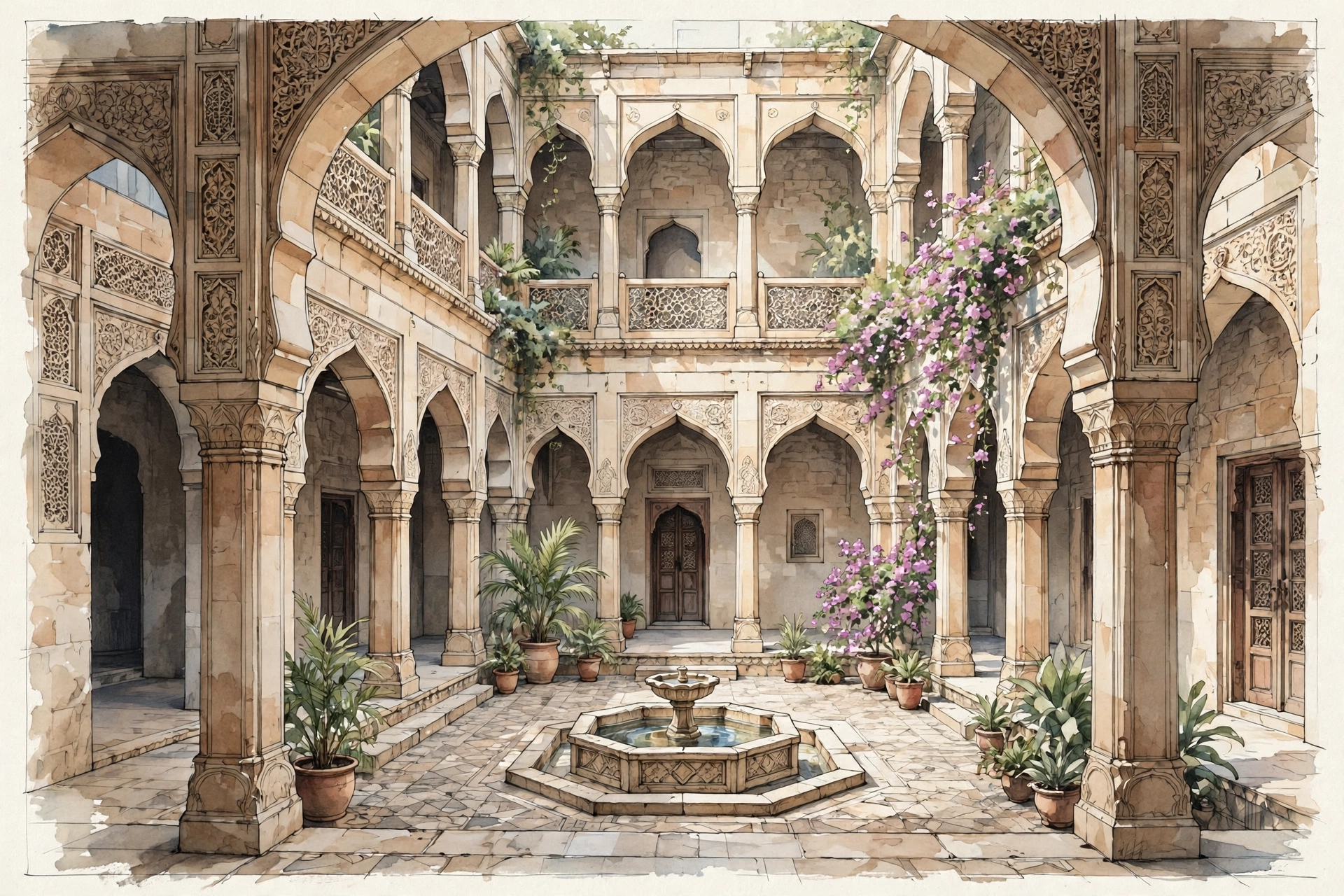
Few Pakistani stories live in two worlds the way Aangan does. It began as a landmark Urdu novel in 1962, became one of Hum TV’s most ambitious period dramas in 2018, and in 2026 it is back on television screens in a re-run that is introducing it to a new generation. This guide looks at the novel, the adaptation, what the drama kept from the book, and where you can watch the re-run now.
The Novel: Khadija Mastoor’s 1962 Classic
Aangan (آنگن, meaning “courtyard”) was written by Pakistani novelist and short-story writer Khadija Mastoor and published in 1962 (Wikipedia). It is widely described as a masterpiece of Urdu literature. The novel won Mastoor the 1963 Adamjee Literary Award for Urdu prose and has since been translated into 13 languages (Wikipedia).
Two English translations have brought the book to international readers: The Inner Courtyard by Neelam Hussain (2001) and The Women’s Courtyard by Daisy Rockwell (2018) (Wikipedia). The literary reference site Rekhta calls it one of the best novels in Urdu, noting that critic Uslub Ahmad Ansari counts it among the 15 best Urdu novels, while Shamsur Rehman Farooqi has said it deserves more attention than it has received (Rekhta).
The novel is usually classified as historical fiction or a period novel, set in 1940s British India and Pakistan. But reviewers argue it is much more: a feminist classic that tells the story of the freedom struggle through the intimate lives of ordinary women, and the price they paid for independence (The Punch Magazine). Rather than focusing on political leaders, Mastoor looks at how Partition reshaped households, marriages, and women’s choices — the “courtyard” of the title standing for the domestic world where history actually landed.
Khadija Mastoor (1927–1982) was one of Urdu literature’s most respected voices. Born in Bareilly, British India, she moved to Pakistan after Partition and wrote several acclaimed short-story collections alongside her two novels, Aangan (1962) and Zameen (1983) (Wikipedia).
The Television Adaptation (Hum TV, 2018)
Hum TV’s adaptation of Aangan aired from December 20, 2018, to June 27, 2019, running for 27 episodes (nettv4u). It was created and produced by Momina Duraid under MD Productions, directed by Mohammad Ehteshamuddin, with the screenplay written by Mustafa Afridi (Wikipedia; Youlin Magazine).
The cast brought together some of the biggest names on Pakistani television: Mawra Hocane as Aaliya, Ahad Raza Mir as Jameel, Sajal Aly as Chammi, Ahsan Khan in the dual role of Subhan and Safdar, Sonya Hussyn as Salma, Hira Mani as Tehmina, and Rabia Butt as Kusum (Wikipedia). Ahsan Khan himself described the project as “based on Khadija Mastoor’s 1962 novel,” directed by Ehteshamuddin and adapted by Afridi, in an interview before the launch (The Free Library).
The serial was highly anticipated, with a large star cast and a high production budget. It mostly received positive reviews from critics, earning praise for its cinematography, visuals, and performances — especially Sajal Aly’s performance as Chammi. It went on to receive multiple nominations at the 19th Lux Style Awards, including Best TV Play, Best TV Actress (both critics’ and viewers’ choice) for Aly, and Best Director (Wikipedia). Trade press at launch called it one of Hum TV’s biggest productions of the season (BizAsiaLive).
As one of the most celebrated page-to-screen transfers in recent Pakistani television, Aangan has a natural place in our guide to Pakistani dramas based on Urdu novels.
Novel vs Drama: What the Adaptation Kept
Adaptations always involve choices, but several things about Aangan‘s move from page to screen are a matter of record. Both the novel and the drama are set in 1940s pre-Partition British India, following a joint Muslim family whose loyalties fracture as the independence movement gathers force (Wikipedia; Wikipedia). The central characters carry the same names in both versions — Aaliya, Chammi, Jameel, Salma, Subhan, Safdar, Tehmina and Kusum — so readers of the novel will recognize the drama’s cast list immediately.
The television format gave the story a new scale: 27 weekly episodes, period costumes and sets, and a large ensemble bringing the household to life visually. Contemporary coverage noted the production’s high budget and its attention to the look and feel of the 1940s (Wikipedia; Youlin Magazine).
One measurable effect of the adaptation: renewed interest in the novel itself. After the drama aired, Aangan became the number one bestselling book in the country in 2019 (Wikipedia) — a reminder that a good adaptation can send viewers back to the source.
A note of caution: detailed scene-by-scene comparisons between the novel and the drama go beyond what published sources document. The fair way to compare them is to read the book and watch the series yourself — which the 2026 re-run makes easier.
The 2026 Re-run
On September 23, 2026, Hum TV announced a re-run of the 2018 drama, with the series also made available on YouTube (Daily Infotainment; TrendingInSocial). To be clear: this is the same 2018 series, not a new drama or a remake.
The re-run is currently airing on Hum TV on Friday and Saturday at 8:00 PM PKT, with episode 5 having aired on October 16, 2026, according to the Pak Drama Schedule listings page (Pak Drama Schedule). (Hum TV’s initial September announcement had listed the drama as “Coming Soon” without a confirmed slot (TrendingInSocial), so check Hum TV’s current schedule for the latest timings.)
Why It Still Matters
More than sixty years after publication, Aangan still speaks. The novel gave Urdu literature one of its finest accounts of how Partition was lived inside homes rather than debated in assemblies, and the television adaptation proved that this kind of literary storytelling could hold a prime-time audience. The 2026 re-run gives a new generation of viewers — many of whom know Sajal Aly and Ahad Raza Mir from newer work — a reason to discover where the story began.
If stories about love, family and history appeal to you, our romantic novels collection has more emotional reads worth exploring.
Frequently Asked Questions
Is Aangan based on a novel?
Yes. The Hum TV drama is based on the 1962 Urdu novel Aangan by Khadija Mastoor. It was directed by Mohammad Ehteshamuddin, adapted for television by Mustafa Afridi, and starred Mawra Hocane, Ahad Raza Mir, Sajal Aly and Ahsan Khan (Wikipedia; Youlin Magazine).
Who wrote the novel Aangan?
Khadija Mastoor (1927–1982), a Pakistani Urdu novelist and short-story writer. Aangan (1962) won her the 1963 Adamjee Literary Award for Urdu prose (Wikipedia).
Is the 2026 Aangan a new drama?
No. The 2026 broadcast is a re-run of the 2018–19 Hum TV series, announced by the channel in September 2026 (Daily Infotainment). Same story, same cast — not a remake.
Where can I watch the Aangan re-run?
The re-run is airing on Hum TV (Friday and Saturday at 8:00 PM PKT, per current schedule listings) and the series is also available on YouTube (Daily Infotainment).
Research date: October 18, 2026.