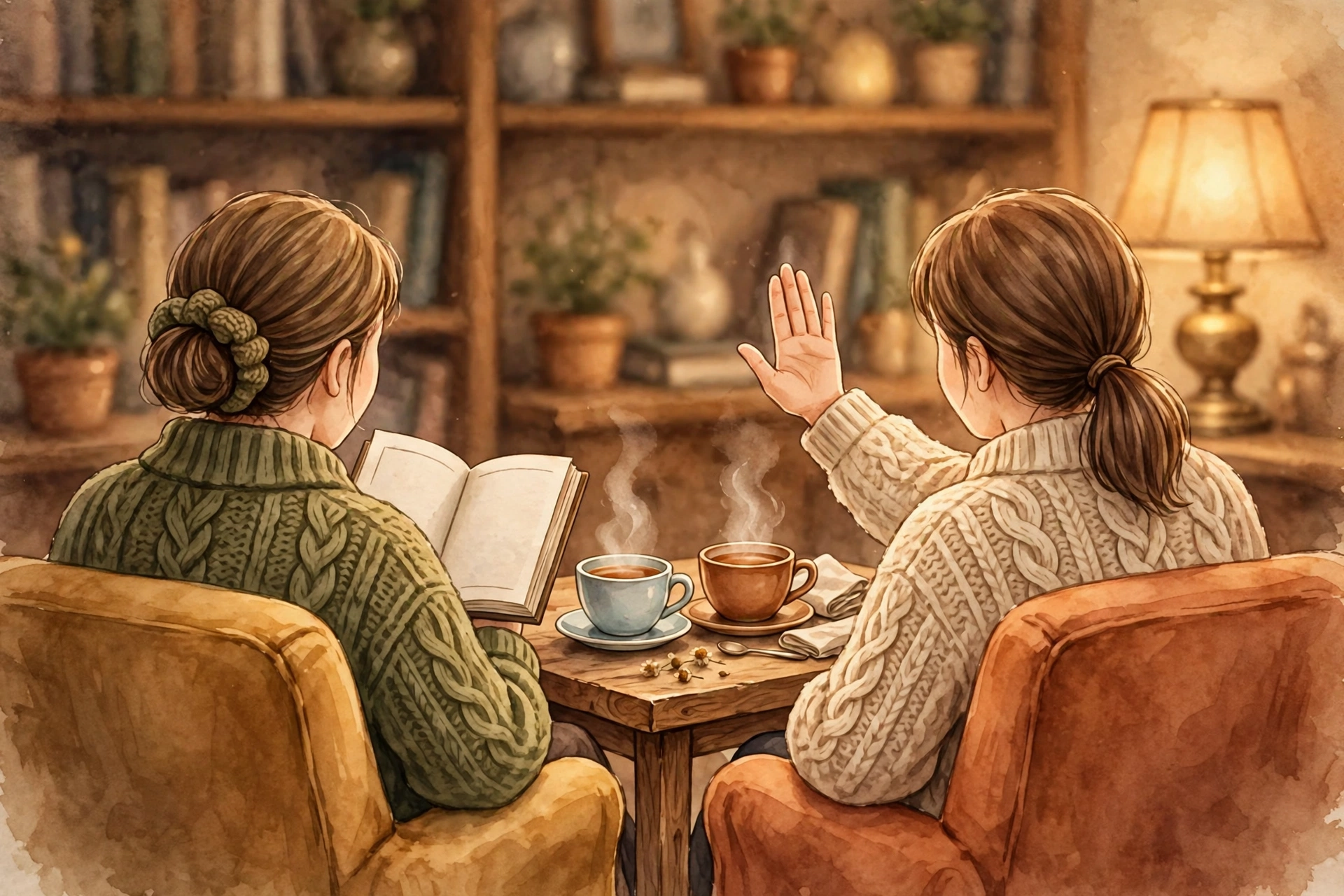
The best part of finishing a good chapter is wanting to talk about it. The worst part is realising, mid-sentence, that the person listening has not reached that chapter yet — and you have just given away the very thing they were looking forward to discovering.
Spoiler-safe discussion is a skill, not just good manners. It lets people at different reading stages enjoy the same conversation: the person who finished yesterday, the person halfway through, and the person who has only just started. This guide covers what counts as a spoiler, the phrases that keep a conversation safe, and what to do when someone has already said too much.
It assumes you have already picked a book. If you have not, start with a choosing guide first. It also pairs naturally with a reading journal: notes you keep for yourself can later become safe talking points, because you already know what you noticed without needing to reveal what happens next. This is a conversation guide, not a group-organisation guide: a book-club guide helps a group meet and discuss together, while this guide is about the conversation itself — how to talk without ruining the story for anyone.
1. First, Agree Where Everyone Is
Every spoiler-safe conversation starts with one question: “Where are you up to?” Ask it before you discuss anything specific, and answer it honestly yourself. A vague answer — “somewhere in the middle” — is not enough, because the middle of a long novel covers a lot of ground. Name a chapter, a scene, or a moment in plain words: “I have just reached the part where the family moves to the new house.”
Then set the boundary out loud: “Let us only talk about things up to that point.” This sounds formal, but it takes five seconds and prevents almost every accidental spoiler. It also gives the person who is furthest behind control over the conversation, which is exactly where control should be.
If you are talking to a group where people are at very different stages, agree to discuss only up to the earliest point anyone has reached. The readers who are further ahead can still talk — about the writing, the setting, the themes — without touching anything that happens later.
2. What Counts as a Spoiler (It Is More Than the Ending)
Most people know not to reveal the ending. But spoilers come in smaller forms that are just as damaging, because they change how someone reads everything that follows:
- Fates and outcomes: who lives, who dies, who leaves, who returns, who ends up with whom.
- Reveals and twists: a hidden identity, a secret relationship, a betrayal, a sudden reversal.
- “Just wait” hints: saying “just wait until you reach chapter twelve” tells the listener that something big happens in chapter twelve, and they will now read every page waiting for it instead of enjoying the story.
- Character-change warnings: “you will hate this character by the end” or “just trust her, she gets better” both spoil the journey, because the reader now judges every scene against your verdict.
- Adaptation spoilers: if a novel has a drama version, details from the drama can spoil the book too, and the other way round. Treat them as the same story for spoiler purposes, unless everyone has seen or read both.
A safe test: if knowing this detail would change how someone experiences the next chapters, it is a spoiler — even if it is not the ending, and even if you think it is “only a small thing.”
3. Safe Things You Can Always Talk About
Spoiler-safe does not mean silent. There is plenty to discuss without touching the plot:
- The writing itself: the pace, the language, whether the opening pulled you in, whether a chapter felt long or short.
- Themes, not events: what the book seems to be about — family duty, ambition, forgiveness, growing up — without saying which character proves the point.
- Setting and atmosphere: the household, the city, the era, and how vividly they are drawn.
- First impressions: what you thought of a character when they first appeared, without predicting where they end up.
- Questions, not answers: “I wonder why she made that choice” is safe; “you will find out she had no choice” is not.
Useful phrases include: “I liked the way the early chapters are written,” “the setting feels very real to me,” “I am curious about where this thread is going,” and “I have a theory, but I will keep it to myself until you catch up.” The last one is important: announcing that you have a theory is fine; sharing the theory is not, until everyone is at the same point.
4. The “Up to Here” Rule
The simplest system is the “up to here” rule: the conversation may only cover what the person who has read least has already read. Everyone else mentally rewinds to that point. This works better than it sounds, because re-reading a story in conversation — noticing details you missed the first time — is often more enjoyable than racing ahead to the newest twist.
When you want to discuss something beyond the boundary, do not hint at it. Say plainly: “There is something later I want to discuss, but we should wait until you reach it.” Then change the subject. The person behind will appreciate the restraint far more than a teasing hint, and the later conversation will be better for the wait.
If you are the person who is behind, do not feel pressured to read faster to “catch up” for a conversation. A good discussion waits for you. Say so if you need to: “Please do not go past this point — I want to discover the rest myself.”
5. When Someone Has Finished and You Have Not
This is the hardest situation, because the finished reader is full of opinions and you are full of curiosity. Both sides have a job to do.
If you have finished, resist the urge to test the other person: do not ask “have you reached the part where…” because the question itself reveals that a notable part exists. Instead, ask open questions about what they have read so far: “What do you think of the family so far?” or “Which character interests you most right now?”
If you have not finished, you can still enjoy the conversation by steering it: “Tell me what you thought of the first half, without anything after that.” And if a spoiler slips out anyway, say so calmly — “that is further than I have read, let us stop there” — rather than pretending you did not hear it. Pretending only leads to more spoilers, because the other person assumes the boundary is further along than it is.
6. Spoiler Rules for Messages and Online Comments
Written discussion needs even more care than spoken discussion, because a reader cannot unsee a sentence:
- Warn first: put a clear spoiler warning at the very start of a message or comment, before any plot detail.
- Do not put the spoiler in the first line: many previews show the first line automatically, so a warning on line one and the spoiler on line three still fails.
- Keep titles and headings spoiler-free: a post titled with a twist gives it away to everyone who scrolls past.
- Hide details where the platform allows it: use spoiler tags, hidden text, or a “read more” cut, and label what is hidden (“spoilers up to chapter ten”).
- Respect the thread’s boundary: if a discussion is marked “up to chapter five,” do not post chapter-twenty thoughts in it, even with a warning — the warning itself tells readers that chapter twenty matters.
These rules also apply to recommending a book. A recommendation should sell the experience — the writing, the world, the feeling of the story — not the plot. If your recommendation only works by revealing what happens, it is not a recommendation; it is a summary with the surprise removed.
7. If a Spoiler Slips Out
It will happen, to everyone, sooner or later. What matters is what happens next.
If you spoiled something, apologise briefly and stop: “Sorry, that was further than you have read — I will not say more.” Do not try to soften it by explaining the spoiler in more detail, and do not insist that “it is not really a spoiler” or “you would have guessed anyway.” The other person’s experience is theirs to judge, not yours.
If you were spoiled, it is worth knowing that a known twist does not ruin a novel. How a story reaches its turning point — the writing, the tension, the character choices along the way — is usually more rewarding than the surprise itself. Many readers enjoy a second reading precisely because they already know what happens. That does not make the spoiler harmless, but it does mean the book is still worth finishing.
Then reset the boundary together, clearly: “Let us agree not to go past this point again.” A spoiler is a mistake; a repeated spoiler, after the boundary is known, is a choice.
8. Talking Across Different Reading Speeds
Families and friend groups rarely read at the same speed. One person finishes in a weekend; another reads a chapter a night for a month. Spoiler-safe habits make that difference painless:
- Use check-in conversations: short talks about “where are you now” keep everyone connected without forcing the same pace.
- Celebrate different stages: the slow reader notices details the fast reader skipped; the fast reader can ask questions that make the slow reader look forward, without answering them.
- Keep a shared safe zone: agree on a few topics that are always safe — the setting, the writing, the themes — so there is always something to talk about.
- Do not use speed as pressure: “you still have not finished?” turns reading into homework. Reading is meant to be enjoyed, and enjoyment does not have a deadline.
The same patience applies when a novel and its drama version are being followed at the same time. Someone watching the drama may be ahead of, or behind, someone reading the book. Apply the same rule: discuss only up to the earliest point anyone has reached, in either version. Our guide to reading classic Urdu novels covers a related patience skill: slowing down for long, demanding books instead of rushing through them.
Conclusion
Discussing a novel without spoiling it is really about one habit: checking where the other person is, and respecting that point as the edge of the conversation. Everything else — safe phrases, warnings, the “up to here” rule — follows from that single respect.
Done well, spoiler-safe discussion is not a lesser conversation. It is often a better one: focused on writing, themes, and first impressions rather than a race to the next twist. And when everyone finally reaches the same point, the full discussion — twists included — is waiting, and it is all the sweeter for not having been rushed.
Frequently Asked Questions
Is it a spoiler to say a book has a sad ending?
Yes, if the listener has not finished it. Knowing the emotional destination changes how every hopeful scene is read. Say instead that the book moved you, without saying in which direction.
Can I discuss a novel with someone who has only seen its drama?
Only up to the point they have reached in the version they know, and remember that the drama may change or reorder events. Treat the two versions as one story for spoiler purposes unless everyone knows both.
What if I accidentally read a spoiler online?
Note where it appeared so you can avoid that source, and keep reading anyway. A novel is more than its twist: the writing, the characters, and the journey to the turning point are still fully yours to discover.
Should I warn about spoilers for old or famous novels?
Yes. “Everyone knows it” is not a safe assumption — every reader meets a classic for the first time once. A short warning costs nothing and protects that first experience.
Is recommending a book without plot details actually possible?
Yes. Recommend the experience: the quality of the writing, the world it creates, the kind of reader who would enjoy it, and how it made you feel — all without describing what happens.