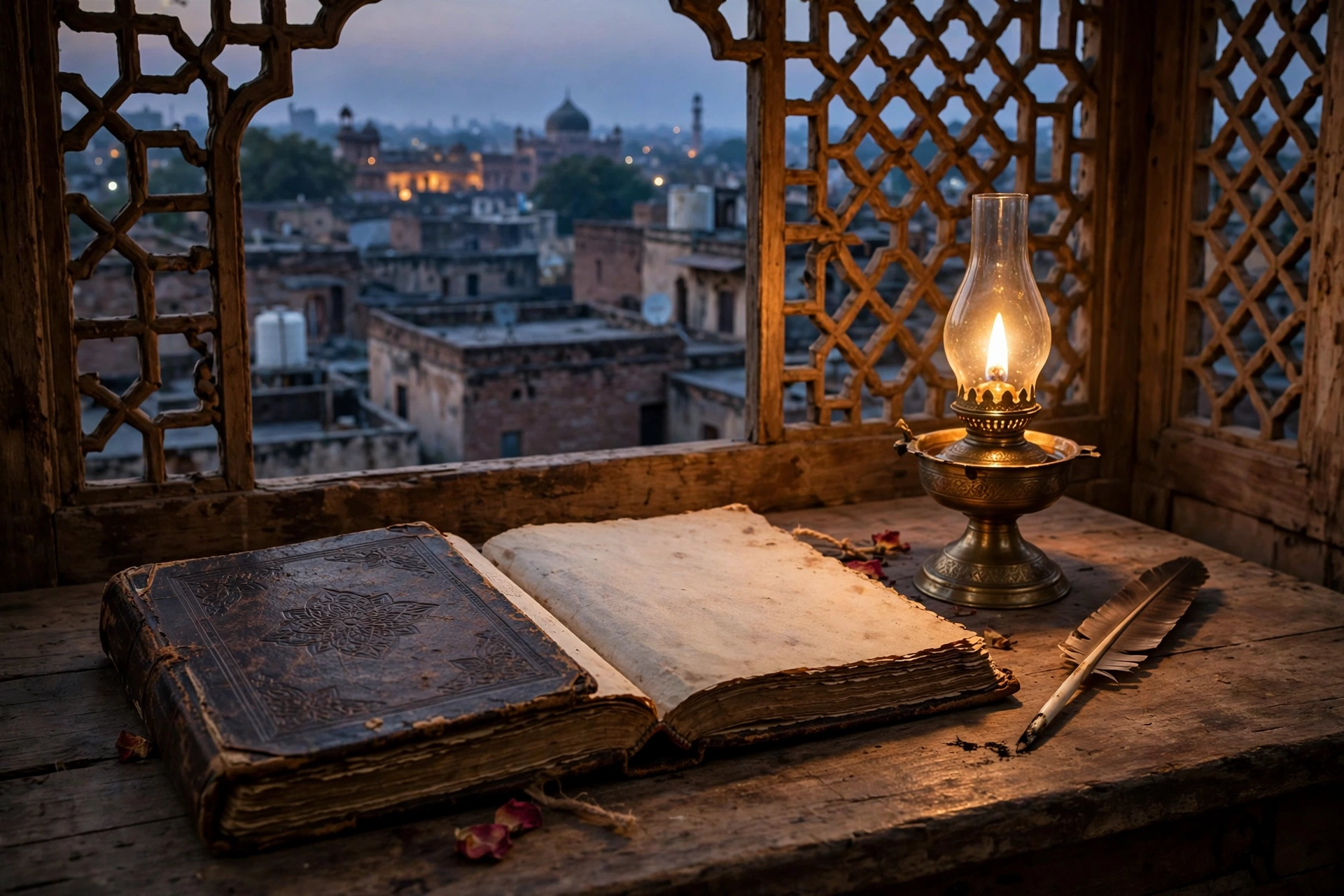
Mirza Ghalib (1797–1869) is the name every Urdu reader meets first, and the shelf behind it is smaller than most readers expect. He wrote no novels, no short stories, no plays of his own. What he left is one Urdu divan of ghazals, a body of Persian poetry several times larger, a handful of prose works, and letters that changed Urdu prose itself. This Mirza Ghalib books guide takes those books one by one: what each one is, what it is not, and where a new reader should start. He is framed here as a poet and letter-writer, not as a novelist.
His Life in Brief
Ghalib was born Mirza Asadullah Beg Khan on 27 December 1797 in Kala Mahal, Agra, into a family of Seljuq Turkic ancestry from Samarkand. His father died in battle when Ghalib was just over five; his uncle, who raised him, died three years later. He married at thirteen, in 1810, and moved to Delhi permanently in 1812. All seven of his children died in infancy.
He began composing poetry at eleven, and at fourteen an Iranian scholar named Abdus Samad stayed two years at his home and taught him Persian, Arabic, philosophy and logic. That education shaped everything: Ghalib valued his Persian work above his Urdu work, and wished to be judged by it. His Persian divan is at least five times longer than his Urdu divan, but his fame rests on the Urdu ghazals.
His life was shaped by money and by courts. A family pension drew him to Calcutta in 1827, where he spent nearly two years petitioning the East India Company; the appeal was rejected in 1831, and the journey produced two Persian masnavis. In 1850 the last Mughal emperor, Bahadur Shah Zafar, gave him the titles Dabir-ul-Mulk and Najm-ud-Daula and made him royal historian; in 1854, on the death of his rival Zauq, Ghalib became the Emperor’s poet-tutor and poet laureate. Three years later the revolt of 1857 destroyed the Delhi he knew. He was questioned by British troops in October 1857 and wrote his diary of those months, Dastanbuy, in Persian. He died in Delhi on 15 February 1869, aged seventy-one, and is buried at Mazar-e-Ghalib, near the Nizamuddin Dargah.
The Books, One by One
Diwan-e-Ghalib (1841) — the one book that matters most
Start here, because almost everything readers mean by “Ghalib” lives in this one book. The Diwan-e-Ghalib is his collected Urdu poetry — ghazals above all, with qasidas, masnavis, qit’as and ruba’is in the full editions. It was first published in Delhi in 1841, and four further editions appeared in his lifetime: 1847, 1861, 1862 (from the Nizami Press in Kanpur) and 1863. The ghazal count differs by edition — about two hundred in the early divan, 234 in Frances Pritchett’s complete index, 273 in the modern standard edition — so no single number is the “true” count.
The ghazals are short, dense and famously difficult to translate: love, philosophy and mysticism folded into two lines at a time. Two of the most quoted open like this:
“hazaron khwahishen aisi ke har khwahish pe dam nikle / bahut nikle mere arman lekin phir bhi kam nikle”
“ye na thi hamari qismat ke visal-e-yaar hota / agar aur jite rahte yahi intizar hota”
Rekhta dates the first ghazal to 1853–1856 and the second to 1848–1852. Other ghazals every reader meets early — dil-e-nadan tujhe hua kya hai, ishq ne Ghalib nikamma kar diya, bazeecha-e-atfal hai duniya mere aage — are named here by title only. A warning is worth giving: many couplets circulating online as Ghalib’s are misattributed, so this guide quotes only couplets verified on Rekhta.
The letters — Ud-e-Hindi (1868) and Urdu-e-Mualla
If the divan is Ghalib the poet, the letters are Ghalib the person — and they are the easiest way into him. He began writing Urdu letters in 1849 or a little earlier, in a simple, conversational prose that broke with the ornate letter-writing of his day. Ud-e-Hindi, the first published collection of his Urdu letters, appeared on 27 October 1868, a few months before his death. Urdu-e-Mualla is another collection of his letters, and Khutoot-e-Ghalib is a modern compilation title rather than a book Ghalib himself published.
The letters are short, funny and self-aware — complaints about money, jokes about his health, sharp judgements on other poets — and they are a landmark of modern Urdu prose. For a reader who finds the ghazals hard going, the letters are the friendlier door. In English, Daud Rahbar’s Urdu Letters of Mirza Asadullah Khan Ghalib (1987) and Ralph Russell’s translations in The Oxford Ghalib carry them across.
Dastanbuy (1858) — the diary of 1857
Dastanbuy is the shortest and most harrowing of his books: a Persian prose diary of the revolt of 1857, covering 11 May 1857 to 1 July 1858, written as both an eyewitness account and a petition to the British. It was published in Agra in November 1858, with a second edition in Bareilly in 1865. For a reader who does not read Persian, Khwaja Ahmad Faruqi’s English translation, Dastanbuy: A Diary of the Indian Revolt of 1857 (1970), is the way in.
The Persian works — the shelf he valued most
Ghalib wished to be judged by his Persian work, and it is the largest part of his shelf — and the hardest for most readers. The Persian divan, Maykhana-e-Arzu, is the centrepiece; its first publication year is disputed, with Rekhta’s chronology giving October 1841 and Wikipedia giving 1845, and this guide records both rather than choosing silently. Around it sit the Persian masnavis from the Calcutta years — Chiragh-e-Dair, composed in the spring of 1827, and Bad-e-Mukhalif, from June 1828 — and the later works: Panj Ahang, a Persian prose work from 1849; Mehr-e-Nimruz, a history of the universe to the death of the Mughal emperor Humayun, from 1855; Qata-i-Burhan, his 1862 critique of the Persian dictionary Burhan-e-Qati; and Abr-e-Guharbar, a Persian masnavi in praise of the Prophet, printed separately in 1864. These are for specialists and Persian readers.
The manuscripts — Nuskha-e-Hamidiya and Gul-e-Ra’na
Two books on the shelf are not books Ghalib published at all, and they matter because they show how the divan was made. Nuskha-e-Hamidiya is the 1821 manuscript of his Urdu divan, containing verses he later discarded; it was found in 1917 in the Hamidiyah Library in Bhopal and published in 1921 as Diwan-e-Jadid. Gul-e-Ra’na is a selection of his Urdu and Persian poetry compiled in September 1828; the manuscript was lost for about a century and published by Malik Ram in 1970. Neither is a separate book by Ghalib, and listing sites that date Nuskha-e-Hamidiya to 1850 are wrong.
The book that is not his — Yaadgar-e-Ghalib
One title turns up in every list and must be kept off his shelf: Yaadgar-e-Ghalib (1897), by Altaf Hussain Hali. It is a biography of Ghalib by his disciple — the book that fixed Ghalib’s life story for later generations — not a book by Ghalib himself. It is Hali’s book, not Ghalib’s.
In English
Ghalib travels better in translation than most Urdu poets, and the English shelf is strong. Aijaz Ahmad’s edited Ghazals of Ghalib (Columbia University Press, 1971) is the classic printed selection. Frances Pritchett’s A Desertful of Roses is an online commentary and translation of the complete Urdu divan, ghazal by ghazal, and the most useful companion a non-Urdu reader can have beside the Urdu text. Ralph Russell, with Khurshidul Islam, wrote Ghalib: Life and Letters, the standard English biography, much of it in Ghalib’s own words through his letters. Sarfaraz K. Niazi’s Love Sonnets of Ghalib is the first complete English translation of the ghazals.
Where to Start: A Reading Order
First, the Diwan-e-Ghalib in a modern standard edition: read the famous ghazals first — hazaron khwahishen aisi, ye na thi hamari qismat — then work through the divan. Non-Urdu readers should keep Pritchett’s A Desertful of Roses open beside the Urdu text. Second, the letters — selections from Ud-e-Hindi or Urdu-e-Mualla — the easiest entry to Ghalib the person. Third, Dastanbuy, short and harrowing, best in Faruqi’s English translation for non-Persian readers. Fourth, the life: Russell and Islam’s Ghalib: Life and Letters. Fifth, only for specialists and Persian readers, the Persian works — Maykhana-e-Arzu, Panj Ahang, Mehr-e-Nimruz — the work Ghalib himself valued most. And for readers who want only the essential Ghalib, the divan and the letters are enough. For the wider company he kept, our Faiz Ahmed Faiz books guide covers the other great Urdu poet of the modern age, our Fahmida Riaz books guide covers a poet who also translated Persian poetry into Urdu, and our Ahmad Nadeem Qasmi books guide covers a poet and prose writer of the next century.
Frequently Asked Questions
Did Ghalib write any novels?
No. He was a poet and letter-writer: one Urdu divan, Persian poetry and prose, and letters — there are no Ghalib novels to list.
Which book of Ghalib should I read first?
The Diwan-e-Ghalib — the Urdu divan, first published 1841. If the ghazals feel hard at first, read the letters (Ud-e-Hindi) alongside them; the letters are the friendlier door.
What is the difference between the Diwan-e-Ghalib and Nuskha-e-Hamidiya?
The Diwan-e-Ghalib is the published collection of his Urdu poetry. Nuskha-e-Hamidiya is an 1821 manuscript of that divan, found in 1917 and published in 1921, containing verses Ghalib later discarded. It is a scholar’s source, not a separate book by Ghalib.
Did Ghalib write more in Persian or in Urdu?
In Persian — his Persian divan is at least five times longer than his Urdu divan, and he wished to be judged by it. His fame, however, rests on the Urdu ghazals.
Where can I read Ghalib in English?
Aijaz Ahmad’s Ghazals of Ghalib (1971) for a printed selection; Frances Pritchett’s A Desertful of Roses online for the complete divan with commentary; Russell and Islam’s Ghalib: Life and Letters for the life; Rahbar’s Urdu Letters (1987) for the letters; Faruqi’s Dastanbuy (1970) for 1857.
Research date: November 7, 2026. Facts verified against Wikipedia (Mirza Ghalib and Diwan-e-Ghalib), Rekhta’s Ghalib ghazals pages and Frances Pritchett’s timeline. Where sources disagree — the Persian divan Maykhana-e-Arzu is dated October 1841 by Rekhta’s chronology and 1845 by Wikipedia; his birth year is given as 1796 by some older sources and 1797 by Wikipedia, Britannica and Rekhta — this guide follows 1797 and records both sides. Ghazal counts differ by edition, so no single count is stated as fact. No publication year is given for Sarfaraz K. Niazi’s Love Sonnets of Ghalib, because no reliable source pins one down.