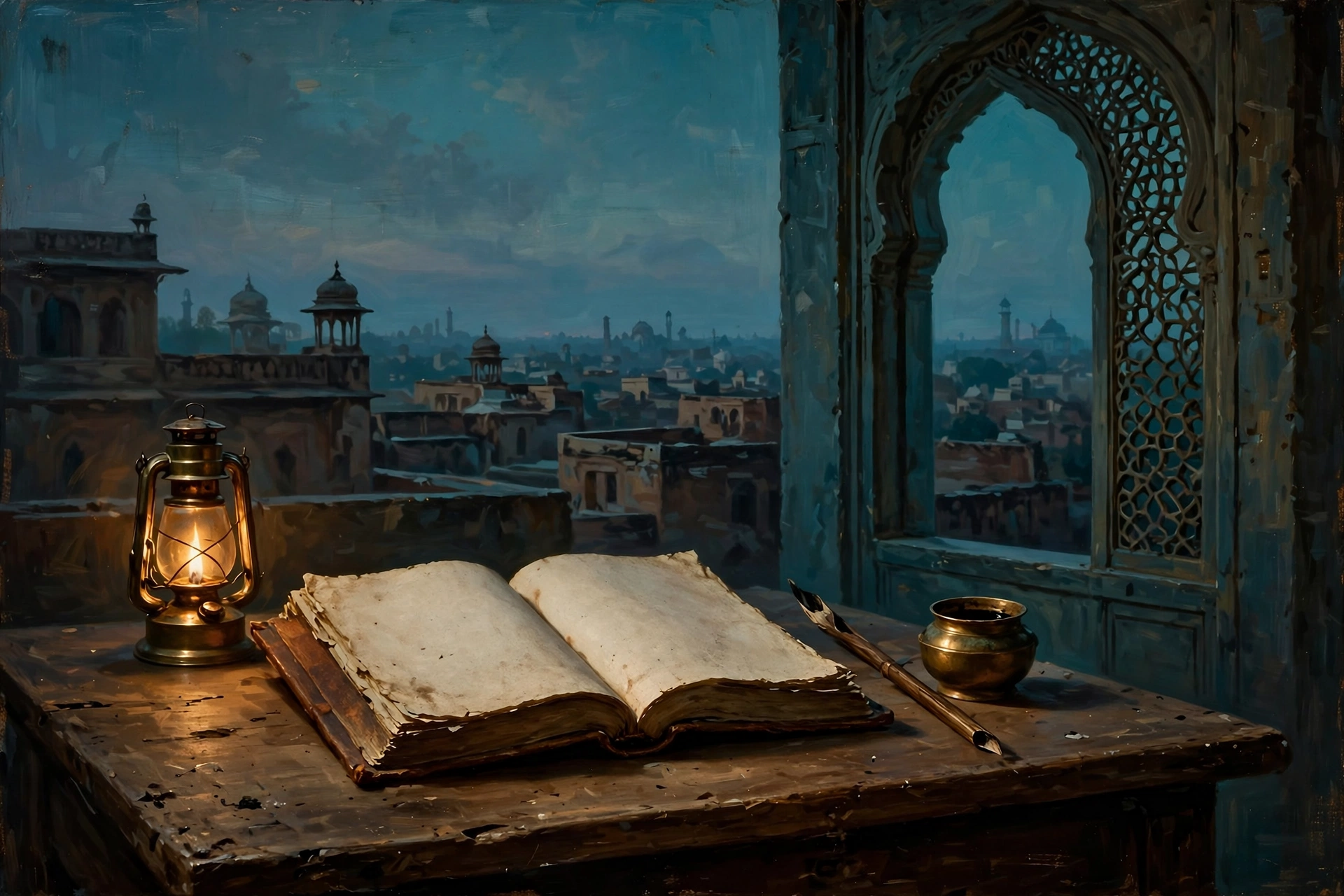
Mir Taqi Mir is the Urdu poet readers meet at the very beginning of the tradition. He wrote in the 1700s, when Urdu poetry was still taking shape, and he is remembered by the title Khuda-e-Sukhan, the God of Poetry. One thing should be said plainly at the start: Mir Taqi Mir was a poet, not a novelist. This mir taqi mir books guide takes his shelf one book at a time — the six diwans of his collected Urdu poetry, his Persian verse, his autobiography and his biographical dictionary of poets. The mir taqi mir books in this guide contain no novels: they hold the largest body of classical Urdu poetry left by a single poet.
A life in brief
Mir Muhammad Taqi was born in Agra, then called Akbarabad, in February 1723, and he died in Lucknow in September 1810, aged eighty-seven. His pen name, his takhallus, was Mir. He was the leading Urdu poet of the eighteenth century, one of the pioneers who gave shape to the Urdu language itself, and one of the principal poets of the Delhi School of the Urdu ghazal. His father was a pious man whose teaching on love and compassion stayed with Mir all his life. His father died while Mir was still in his teens and left him some debt, and his step-brothers seized his inheritance. After his father’s death he left Agra for Delhi, to finish his education and to find patrons, and in 1782 he moved to Lucknow, at the invitation of the ruler Asaf-ud-Daulah, where he spent the rest of his life.
Agra and Delhi: the making of a poet
Mir was born into a family of very modest means in Agra. After his father died, his step-uncle took care of him, and after that uncle’s death his maternal step-uncle did. He left Agra for Delhi a few years after his father’s death, and in Delhi he found support at court: the Mughal courtier Khan-i Dauran gave him a daily allowance. Rekhta’s profile tells the same early story with different names: Mir was left on his own at eleven and was introduced in Delhi to Nawab Samsamuddaulah, who provided for him until the nawab was killed facing Nadir Shah’s attack. It was in Delhi that he became a poet of Urdu. According to his own account, Syed Sadaat Ali, a Sayyid of Amroha, convinced him to write poetry in Urdu, and his verse soon became well known. His Delhi address was Kuchha Chelan, in Old Delhi.
Delhi in ruins and the move to Lucknow
Mir’s Delhi did not last. He lived through the attacks of Nadir Shah and Ahmad Shah Abdali on the city, and the decline of the Mughal Empire, and his poetry carries the grief of that ruin. Ahmad Shah Abdali sacked Delhi each year starting in 1748. The signature of his poetry is the grief he expresses over the downfall of his city. In 1782 he left Delhi for Lucknow, at the invitation of Asaf-ud-Daulah, and stayed there for the remainder of his life. He was given a kind welcome, but the courtiers of Lucknow considered him old-fashioned, and he dismissed the poet Jur’at’s work as merely “kissing and cuddling”. His relations with his patron gradually grew strained, and he eventually severed his connections with the court. In his last years he was very isolated: his health failed, and the deaths of his daughter, his son and his wife caused him great distress.
Kulliyat-e-Mir: six diwans, 13,585 couplets
His complete works, the Kulliyat, consist of six diwans containing 13,585 couplets, in a variety of poetic forms: ghazal, masnavi, qasida, rubai, mustezaad, satire and more. Rekhta’s profile confirms the shape of the shelf: six divans of Urdu and one of Persian ghazals, apart from his mathnawi, musaddas, qasida, hajw and wasokht. Thirteen thousand five hundred and eighty-five couplets, gathered across a long life into six volumes, make Mir’s collected work one of the largest bodies of poetry in Urdu. His Persian poems form a separate collection, the Kulliyat-e-Farsi, but the Urdu diwans are the work his reputation rests on, and no date is established for when the Persian poems were gathered.
The ghazals
Mir’s literary reputation is anchored on the ghazals in his Kulliyat-e-Mir, many of them on themes of love. He is noted for his poetry of pathos and melancholy, and the death of his family members, together with his earlier setbacks in Delhi, lend a strong pathos to much of his writing. The ghazals are the place to meet him: love poems that are also poems of loss, in a language that is simple on the surface and hard underneath.
Mu’amlat-e-Ishq and the masnavis
His masnavi Mu’amlat-e-Ishq, “The Stages of Love”, is one of the greatest known love poems in Urdu literature. It is a long narrative poem rhymed in couplets, written in the first person, and some scholars consider it, with another masnavi, Khwab o Khyal-e Mir, “Mir’s Vision”, to have been inspired by Mir’s early love affairs. How autobiographical these accounts are is by no means clear: the scholar Frances W. Pritchett notes that the austere portrait drawn from these masnavis must be set against a very different picture drawn by Andalib Shadani. The masnavis are poems, not a diary, and they do not settle the facts of his life.
The prose shelf: Zikr-e-Mir, Nikat-ush-Shuara and Faiz-e-Mir
The main source of information on Mir’s life is his autobiography, Zikr-e-Mir, written in Persian, which covers the period from his childhood to the beginning of his sojourn in Lucknow. It is said to conceal more than it reveals, with undated material in no chronological sequence, so many true details of his life remain speculation. Read it as a poet’s account of himself, not as a dated record. His second prose work is Nikat-ush-Shuara, a biographical dictionary of the Urdu poets of his time, written in Persian — one of the earliest accounts of its kind, and the reason later scholars can trace the Delhi School at all. His third is Faiz-e-Mir, five stories about Sufis and faqirs, said to have been written for the education of his son, Mir Faiz Ali.
Style and language
Mir lived at a time when the Urdu language and poetry were at a formative stage, and his instinctive sense of beauty helped him strike a balance between the indigenous expression and the new enrichment coming in from Persian imagery and idiom, to make the new elite language known as Rekhta, or Hindui. He based his language on his native Hindustani, leavened it with Persian diction, and created a poetic language at once simple, natural and elegant, which guided generations of poets.
Mir and Ghalib
Mir’s most famous comparison is with the later poet Mirza Ghalib, who was born in 1797, thirteen years before Mir died. Lovers of Urdu poetry often debate Mir’s supremacy over Ghalib, or the other way round. Ghalib himself acknowledged, in his own couplets, that Mir was a genius who deserved respect — he wrote that he was not the only master of Rekhta, and that there used to be a Mir in the past. Ghalib’s regard is the best evidence a reader needs that Mir stands at the head of the tradition.
Mir in later culture
Mir has stayed in the public eye long after his death. Khushwant Singh’s novel Delhi: A Novel gives details about the life and adventures of the poet, and Mah-e-Mir, a 2016 Pakistani biographical film directed by Anjum Shahzad, put him on screen, with Fahad Mustafa playing Mir. His burial place is no longer traceable: the marker of his grave is believed to have been removed when railway tracks were built over it, and in the 1970s a cenotaph was built near it, with the help of Maqbool Ahmed Lari, founder of the Mir Academy in Lucknow.
Where to start reading
Start with the Kulliyat-e-Mir itself, and read the ghazals first: they are the core of his work and the reason for his reputation. A new reader does not need to read all six diwans in order; the first diwan is the natural place to begin. After the ghazals, read the masnavi Mu’amlat-e-Ishq, then the autobiography Zikr-e-Mir for the life behind the verse, and Nikat-ush-Shuara for the world he moved in.
Readers who enjoyed this guide may also like the other books guides on this site: the Mirza Ghalib books guide; the Ibn-e-Insha books guide; and the Ahmed Faraz books guide.
Dates and details that differ across sources
A reader who looks him up in more than one place will find details that do not agree. His birth is given as February 1723 by Wikipedia‘s infobox, as August or February 1723 in the body of the same article, as August or September 1723 in older versions of it, and as 1722/23 by Rekhta‘s profile; one scholarly translation of his autobiography is even titled for the years 1725 to 1810. This guide uses February 1723. His death is given as 20 September 1810 in the infobox and 21 September 1810 in the body of the article, so this guide gives September 1810 and leaves the day open. Wikipedia gives two different names for his father in different sections, and Rekhta says he was left on his own at eleven, while Wikipedia says his father died while he was in his teens. Wikipedia names his Delhi patron Khan-i Dauran; Rekhta names Nawab Samsamuddaulah. Wikipedia says a Sayyid of Amroha named Syed Sadaat Ali turned him to Urdu poetry; Rekhta says his father had Syed Amanullah mentor him. His name is spelled Mir in some sources and Meer in others. The title Khuda-e-Sukhan is widely used and appears in older versions of the Wikipedia article, but it is a title from readers and critics, not a formal honour.
Frequently asked questions
Did Mir Taqi Mir write novels?
No. He was a poet, and his books are collections of poetry in Urdu and Persian, an autobiography, a biographical dictionary of poets and a book of stories about Sufis. This guide is a books guide rather than a novels guide for exactly that reason.
What is Kulliyat-e-Mir?
His collected Urdu poetry: six diwans containing 13,585 couplets, in forms including the ghazal, the masnavi, the qasida, the rubai and satire. His Persian poems form a separate collection, the Kulliyat-e-Farsi.
What does Khuda-e-Sukhan mean?
It means “God of Poetry”, the title by which Mir is remembered in Urdu letters.
When did Mir Taqi Mir move to Lucknow?
In 1782, at the invitation of Asaf-ud-Daulah, after the repeated sackings of Delhi. He stayed in Lucknow for the rest of his life.
Which Mir Taqi Mir book should I read first?
Start with the ghazals in the Kulliyat-e-Mir, beginning with the first diwan. Then read the masnavi Mu’amlat-e-Ishq, and after that the autobiography Zikr-e-Mir.
Closing
Mir Taqi Mir’s shelf is the foundation of Urdu poetry: six diwans of Urdu verse, a diwan of Persian ghazals, an autobiography, a biographical dictionary of poets and a book of Sufi stories. He lost his father young, his city to invaders, and his family in old age, and turned all of it into verse so plain and so exact that two hundred years of poets after him measured themselves against it. Ghalib’s regard says it best, and simply: there used to be a Mir.
Research date: November 10, 2026.
Additional Details
- Name: Mir Taqi Mir Books: A Reader’s Guide
- Description: Mir Taqi Mir books guide: the six diwans of Kulliyat-e-Mir, Zikr-e-Mir, his life from Agra to Lucknow, style and where to start.
- Published: 2026-11-10T15:59:00+05:00