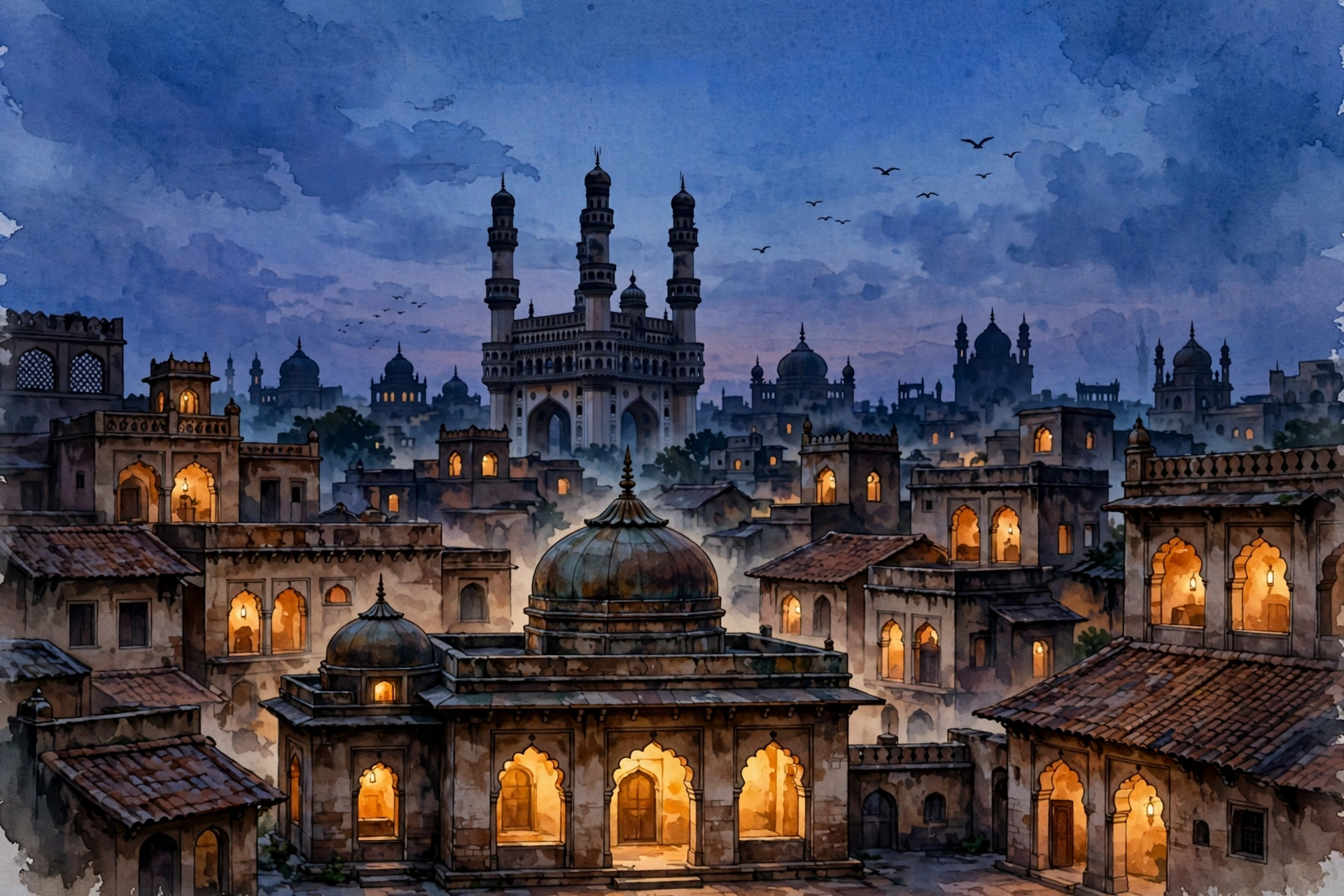
Before anything else, a necessary clarification: the Hyderabad in this guide is Hyderabad Deccan, in India — the historic princely state and its capital city — not the Hyderabad in Sindh, Pakistan. The two cities share a name and little else, and every novel listed below belongs to the Deccan city: its nawabi households, its old-city streets, its Osmania-educated middle class, and the world that ended with the Police Action of 1948 and the years that followed.
That world produced a small but remarkable shelf of Urdu novels. Hyderabad Deccan was, for much of the twentieth century, one of the great centres of Urdu culture, and its writers recorded a society in slow collapse: feudal landlords losing their grip, educated women pushing against old limits, and families caught between a princely past and an independent India. The five novels below are the strongest starting points for a reader who wants to meet that city through fiction. They are all Urdu novels set in Hyderabad, and each one shows a different corner of the same city.
1. Shabnam — Aziz Ahmad
Shabnam is the most intimate of Aziz Ahmad’s Hyderabad novels, and the best place to start. It is set in Hyderabad — called Farkhundanagar in the novel — in the mid- to late 1940s, on the eve of the Police Action of 1948. The heroine, Shabnam, is a writer and a teacher of Urdu at a local convent school, a working woman in a middle-class society where a woman’s reputation was public property.
The novel follows the gossip and scandal that gather around her: rumours of romantic relationships, circulated and believed, that block her search for a meaningful relationship. Ahmad, who spent the first half of his life in Hyderabad and taught at Osmania University, writes as someone who knew this society from the inside — its drawing rooms, its newspapers, its small cruelties. What makes the book worth reading today is not the scandal itself but what it reveals: how a closed middle-class world managed change, especially the change brought by higher education and employment for women. Read it first if you like character-driven fiction and social observation rather than grand historical sweep.
2. Aisi Bulandi, Aisi Pasti — Aziz Ahmad
Aisi Bulandi, Aisi Pasti is the earlier and grander of Ahmad’s two Hyderabad novels, and the one that has travelled furthest: Ralph Russell translated it into English as The Shore and the Wave in 1971. In Russell’s introduction, the fictional city of Farkhundanagar is identified plainly — it is, in fact, Hyderabad, capital of the large princely state that survived under British paramountcy until 1947.
The novel describes the impact of westernisation on the educated, well-to-do sections of Hyderabad society in the period up to the eve of independence, and tells its story through the marital and social entanglements of its families. Where Shabnam looks at the middle class, this novel looks upward, at the landlords and nawabs whose world was already coming apart. Ahmad was born in Hyderabad Deccan in 1914, taught English at Osmania University from 1938, and served for a time as private secretary to Princess Durr-e-Shehwar of the Nizam’s family, so the milieu he describes is one he lived in. Read it if you want the big canvas — a whole society at the edge of a historical cliff — and read the English translation alongside the Urdu original if you read both languages.
3. Alam Panah — Rafia Manzurul Amin
Alam Panah is the least widely discussed novel on this list, and the one with the most unusual afterlife: it became the DD National television serial Farmaan in 1994, directed by Lekh Tandon, which ran for 14 episodes. The novel is set in Hyderabad, in a former royal family, and follows the household of Badi Sarkar, a widowed matriarch, and her elder son Azar Nawab — a family of old standing learning to live in a world that no longer belongs to it.
The story moves between Hyderabad and Dandeli, where the family had a timber business, and its centre is the arrival of a young woman hired as an assistant in the household. It is a gentler book than the two Ahmad novels: less concerned with scandal or political rupture, more interested in how an old household adjusts, quarrels, and carries on. Readers who enjoy domestic drama and the atmosphere of a nawabi household — its manners, its Urdu, its slow rhythms — will find it rewarding. The serial’s survival in public memory also makes it an easy entry point: many readers first meet the story on screen and then come to the novel. Note the author’s name is also spelled Manzoorul Ameen in some listings.
4. Aiwan-e-Ghazal — Jeelani Bano
Aiwan-e-Ghazal is the landmark novel of this list. Jeelani Bano (1936–2026) was born in Badaun, raised in Hyderabad Deccan, and is remembered as one of the major chroniclers of Hyderabadi culture in Urdu fiction. Her novel portrays, with artistic depth, the decline of Hyderabadi feudal culture, the Telangana movement, the impact of Partition, and the fall of the Asaf Jahi state.
That is a great deal of history for one novel to carry, and Bano carries it through lived experience rather than abstraction: the division of families, the strain on inherited relationships, and the slow decline of feudal values, all seen from inside the households affected. The novel’s women — including Qaiser and her daughter Kranthi, who join the radical squads of the Telangana armed rebellion — are not symbols but people making hard choices. Bano received the Padma Shri in 2001 and died in Hyderabad on 1 March 2026, aged 89. Read this novel if you want the fullest single portrait of Hyderabad’s twentieth-century transformation, and if you are comfortable with a book that asks for patience and repays it.
5. Barish-e-Sang — Jeelani Bano
Barish-e-Sang (1985) is Bano’s second major novel and the companion piece to Aiwan-e-Ghazal. Where the earlier novel ranges across the great ruptures of Hyderabad’s history, this one turns inward: it explores the psychological and political effects of feudalism, particularly in Telangana’s rural world, and both novels together explore women’s position in the feudal society of Hyderabad.
The title means a rain of stones, and the book earns it — it is a harder, more concentrated read than Aiwan-e-Ghazal, focused on the injuries of everyday life in a hierarchical society: the preference for sons, the wait for a suitable match, the disregard for women’s feelings. Read it after Aiwan-e-Ghazal, not before; the two books share a world, and the second deepens what the first establishes. Together, they are the most complete fictional account of Hyderabad’s feudal order and the women who lived inside it.
How to read these five novels
If you are new to Urdu novels set in Hyderabad, start with Shabnam for the city at street level, then read Aisi Bulandi, Aisi Pasti for the wider social canvas, and finish with Bano’s two novels for the long view of feudal decline. Alam Panah can be read at any point — it is the lightest of the five and a good rest between heavier books. Readers who enjoy comparing how different cities shape Urdu fiction may also like our guides to Urdu novels set in Lahore and Urdu novels set in Karachi, and our comparative guide to how four Urdu novels treat Partition differently — several of the Hyderabad novels touch Partition, but each one treats it in its own way.
What this guide leaves out
A careful reader will notice some famous names missing, and the omissions are deliberate. Aziz Ahmad’s Aag is one of his best-known novels, but it is set in Kashmir, not Hyderabad, so it does not belong here. Zeenuth Futehally’s Zohra is a novel of Hyderabad life, but it was written in English. Wajida Tabassum wrote powerfully about Hyderabad, but her best-known work is in short stories rather than novels. And Aag Ka Darya, for all its greatness, has no confirmed Hyderabad setting. A guide is only useful if its boundaries are honest, so these titles stay out — each of them deserves its own guide, on its own terms.
Frequently asked questions
Which Hyderabad do these novels describe?
Hyderabad Deccan, in India — the capital of the former princely state of Hyderabad. They do not describe the Hyderabad in Sindh, Pakistan. The Deccan city’s nawabi culture, its Osmania University, and the fall of the Asaf Jahi state are the world these novels belong to.
Which novel should I read first?
Start with Shabnam by Aziz Ahmad. It is the most accessible of the five, its middle-class Hyderabad is easy to enter, and it gives you the city’s social atmosphere before you take on the larger historical canvases of the other novels.
Are these novels available in English?
At least one is: Aisi Bulandi, Aisi Pasti was translated by Ralph Russell as The Shore and the Wave in 1971. For the others, no widely known English translation has been verified for this guide, so they are best read in Urdu.
Was Alam Panah really made into a television serial?
Yes. Farmaan, broadcast on DD National in 1994 and directed by Lekh Tandon, was based on Alam Panah and ran for 14 episodes. It is the only screen adaptation among the five novels in this guide.
How do Jeelani Bano’s two novels differ?
Aiwan-e-Ghazal takes the wide view — the decline of feudal culture, the Telangana movement, Partition, and the fall of the Asaf Jahi state. Barish-e-Sang (1985) is narrower and more intense, focused on the psychological and political effects of feudalism and on women’s position within it. Read them in that order.
Why are there only five novels in this guide?
Because only five Urdu novels set in Hyderabad with a verified Deccan setting passed this guide’s checks. Titles that are set elsewhere, written in English, or are short-story collections rather than novels were left out, even when they are famous. A shorter honest list serves readers better than a longer uncertain one.
Sources
- Maidaanam — “Sex, Gossip, and Scandal in 1940s Hyderabad: Aziz Ahmad’s Novel Shabnam” (setting, heroine, Police Action eve): maidaanam.com
- Dareechah — Aziz Ahmad profile (life dates, Osmania career, novel list and years): dareechah.com
- Rekhta — Jeelani Bano profile (life, works, Aiwan-e-Ghazal description, death 1 March 2026, Padma Shri 2001): rekhta.org
- The News — “The Quiet Resistance of Jeelani Bano” (death in Hyderabad 1 March 2026 aged 89; both novels’ years; women’s position in feudal Hyderabad): thenews.pk
- Wikipedia — Farmaan (Alam Panah, set in Hyderabad; DD National 1994; 14 episodes; Lekh Tandon): en.wikipedia.org
- Wikipedia — Jeelani Bano (bibliography years, 1976 and 1985): en.wikipedia.org