Introduction: how this list was checked
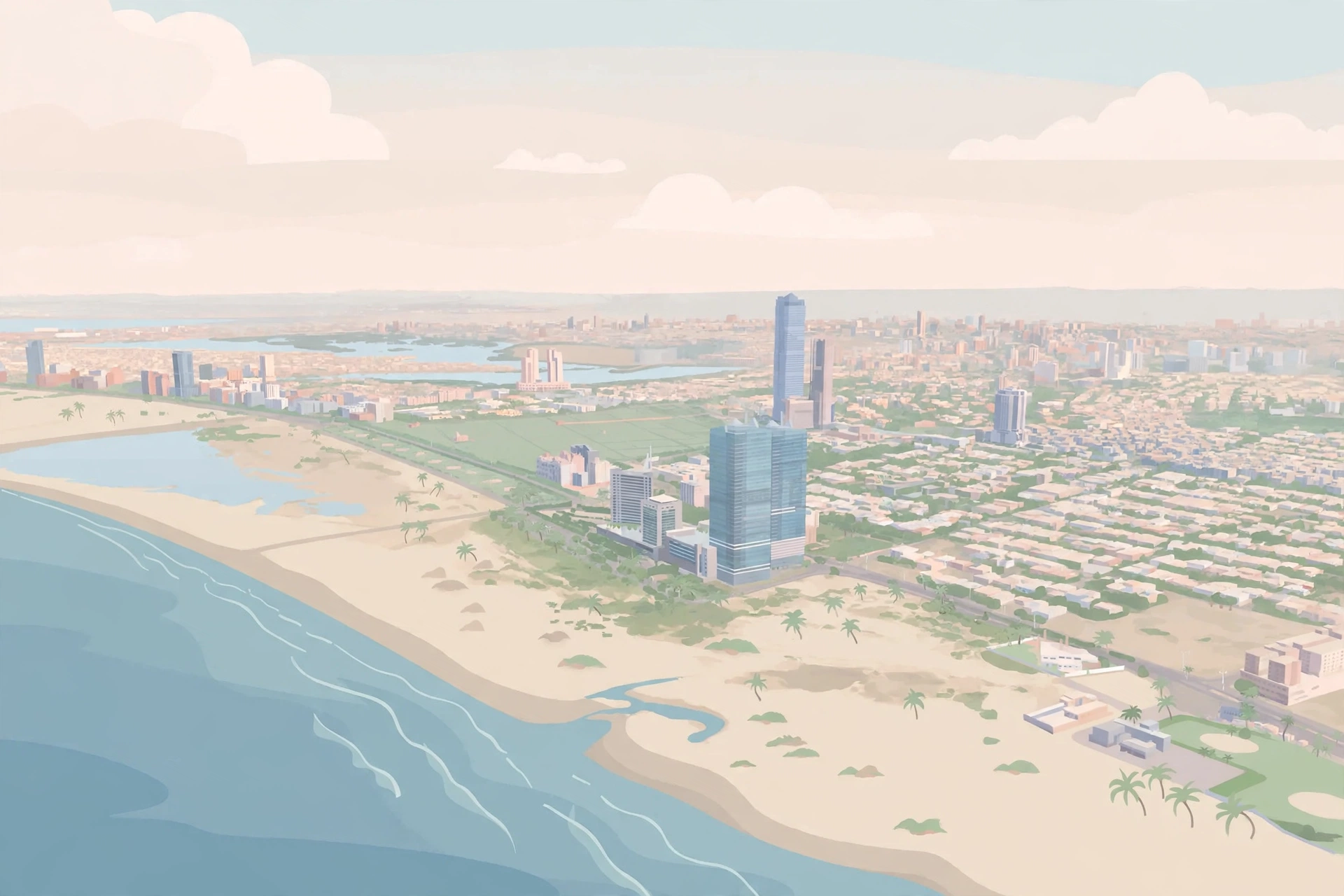
Karachi is not one kind of setting in Urdu fiction: a port city that received migrants after Partition, of slums and mansions, and of people who leave and return. This guide follows that range, as a sibling of the site’s Lahore guide but a different list — different city, different titles, and a selection logic built around migration, the sea, and return.
A novel is included only when a source checked for this guide placed its action in Karachi; where the evidence is weaker — an adaptation summary or a listing site rather than a publisher or critical source — the entry says so. And where a book was written is not where it is set.
No neighbourhood-level claims are made: the sources checked name the city, not streets or areas, so this guide invents none.
Karachi as a new home: migration and the port city
Khuda Ki Basti by Shaukat Siddiqui
The oldest Karachi novel here, published in 1957, follows a poor but respectable family — a widowed mother, her daughter Sultana, and her younger brother Annu — in a slum built after independence in 1947, where scarce work leaves them exposed to exploitation.
The evidence is strong but needs one qualification: Wikipedia describes life in a Karachi slum, while another description places the action in the 1950s slums of Karachi and Lahore. Read it as partly Karachi, centred on the Karachi slum.
Aage Samundar Hai by Intizar Husain
If Khuda Ki Basti is Karachi at its founding, this is Karachi decades later. Published in 1995, it is academic-paper-verified: a 2019 journal paper calls it a Karachi narrative revolving mainly around Muhajir characters, and the publisher’s author page contrasts the urban violence of contemporary Karachi with a vision of lost al-Andalus.
It follows migrants from different towns in India who hold on to the customs of their origin in a city whose law and order is breaking down. Nostalgia here is not decoration: it is how the characters explain who they are, and the novel asks whether migrating still holds up under present pressure.
Wealth, family and return: Karachi’s drawing rooms
Humsafar by Farhat Ishtiaq
This is the guide’s weakest evidence level, labelled as such. Published in parts in Khawateen Digest from July 2007 to January 2008, it follows Khirad, a middle-class girl from Hyderabad who marries Ashar, whose wealthy family lives in Karachi; years later she returns to that home with her young daughter to seek help for the child’s treatment.
The Karachi details rest on adaptation summaries, which place Ashar’s family home in Karachi and Khirad’s later return there; novel summaries checked did not name the city. Treat this one as partly Karachi on adaptation-level evidence.
Jo Bachay Hain Sang Samait Lo by Farhat Ishtiaq
This is a novel of return. Sikandar, a Harvard-trained lawyer living solitarily abroad, meets Liza, an Italian-raised artist with Pakistani roots, in Rome. The story moves across Italy, London and Pakistan before bringing them back to Karachi, where Sikandar seeks reunion with his family and old accusations resurface.
The Karachi evidence is a listing-site summary stating that the couple travels back to Karachi — enough to include it as partly set in Karachi, though most of the story happens elsewhere.
Bin Roye Ansoo by Farhat Ishtiaq
This short 2010 novel turns on a triangle: Saba loves her cousin Irtiza, who sees her only as a friend, while Irtiza falls in love in America with Saman, who turns out to be Saba’s elder sister. Its later section brings them to Karachi with their young son, where a family tragedy reshapes everything.
The Karachi evidence is again a listing-site summary stating that Irtiza and Saman come to Karachi with their son; include this one for its closing Karachi section only.
The inner city: faith, self and elite life
Shehr-e-Zaat by Umera Ahmed
This short work, first published in Khawateen Digest, is the guide’s most inward Karachi story. Falak, the only child of very rich parents and a fine-arts student, sculpts the man of her dreams and meets him in life, only for the marriage to unravel through infidelity — and her response is a spiritual journey away from beauty, wealth and romantic love towards God and a self not dependent on them.
The setting evidence is the author herself as reported by Wikipedia: Umera Ahmed mentions the story plot as set in Lahore and Karachi. This is therefore a partly-Karachi work, its Karachi the elite, wealthy city — a contrast with Khuda Ki Basti‘s slum and Aage Samundar Hai‘s migrant Karachi.
How to choose
For serious, literary Karachi, start with Khuda Ki Basti or Aage Samundar Hai: the first shows the city at its poorest in the years after Partition, the second decades later, through memory, identity and urban violence.
For romance-led stories, start with Humsafar, Bin Roye Ansoo or Jo Bachay Hain Sang Samait Lo. Our Best Romantic Urdu Novels guide groups widely loved titles by mood for comparison.
For something short and reflective, choose Shehr-e-Zaat: its question — what remains of a person when wealth and beauty stop answering — is asked in a Karachi of privilege rather than of struggle.
If you are choosing between cities, our Lahore guide covers campus life and Partition-era memory in Lahore, while this guide covers port-city migration and return in Karachi. If you are still unsure how to narrow a list, our guide to choosing your next Urdu novel offers a framework based on mood, time, experience and theme.
Frequently asked questions
Are all six novels set entirely in Karachi?
No. Only Aage Samundar Hai is centred on Karachi throughout, on the sources checked. Khuda Ki Basti and Shehr-e-Zaat are partly set in Karachi alongside Lahore, and the other three use Karachi for one important part — a family home, a return, or a closing section.
Which book should I read first?
Start with Khuda Ki Basti for social realism, or Aage Samundar Hai for reflective fiction about migration and memory. For romance, Humsafar; for something short, Shehr-e-Zaat.
Do I need to know Karachi to enjoy these novels?
No. Each novel explains its world through its characters. Knowing Karachi adds recognition — a port city built by migration, slum and mansion side by side, the pull of return — but the stories work on human questions first.
Why are some famous Urdu novels missing from this list?
Because a Karachi connection could not be verified for them in the sources checked. Mushaf, Meri Zaat Zarra-e-Benishan, Woh Yakeen Ka Naya Safar and Haalim had summaries checked naming no city, and Mere Bhi Sanamkhane is set in Lucknow of the 1940s on the evidence found, not Karachi. Aag Ka Darya is the clearest example: Hyder wrote it in Mauripur, Karachi, but checked summaries place its modern-era action in Lucknow, Cambridge and Calcutta, with migration to Pakistan named but no Karachi setting. Where a book was written is not where it is set, so those books were left out rather than included on a guess.