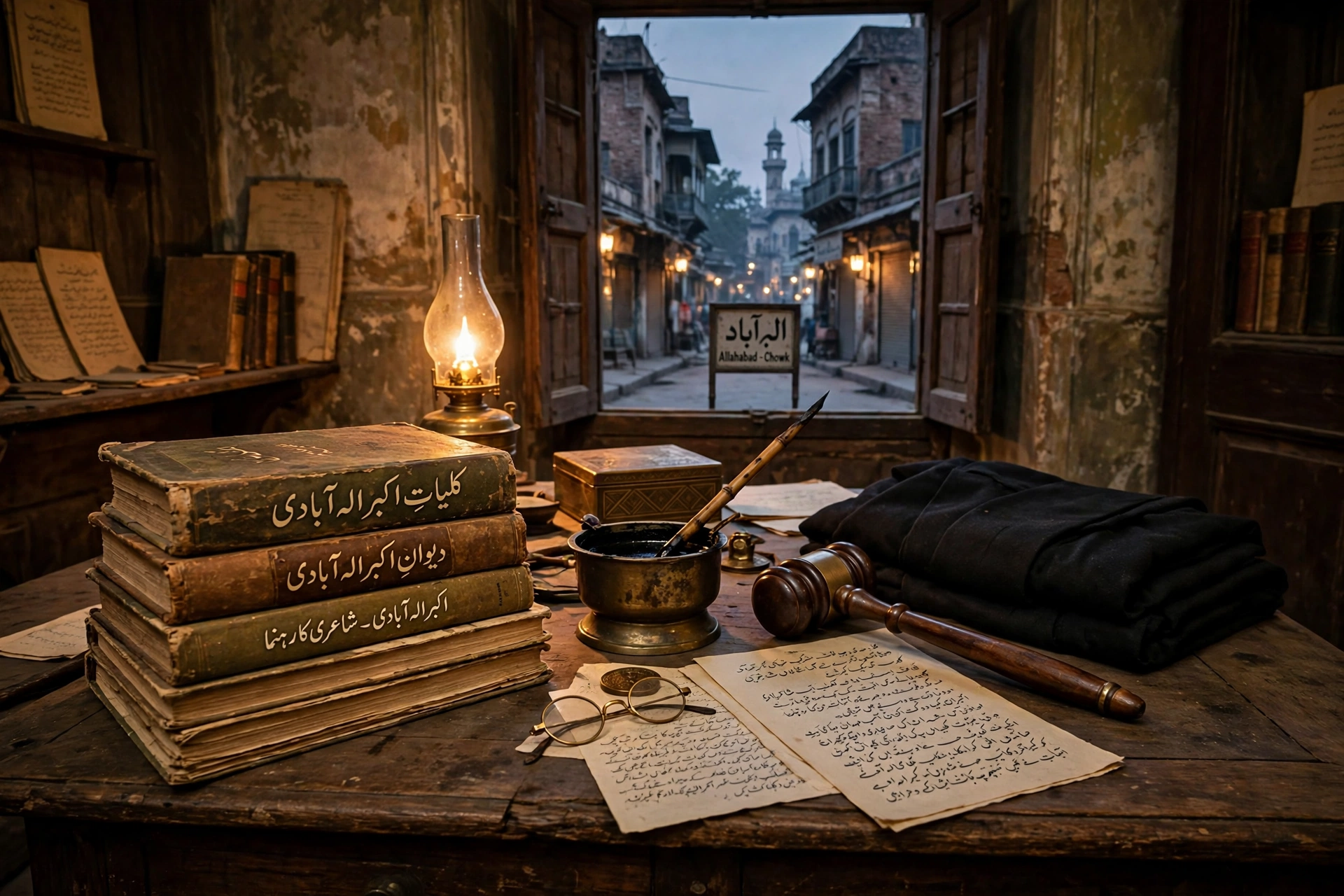
Akbar Allahabadi is the Urdu poet most readers meet first through a song, not a book. His ghazal “Hungama Hai Kyon Barpa” has been sung by Ghulam Ali into millions of homes, and lines of his verse found their way into Nusrat Fateh Ali Khan’s qawwali “Tum Ik Gorakh Dhanda Ho” and into the 2015 Hindi film Masaan. Behind the famous lines stands a man with an unusual double life: a sessions judge of the British Raj by day, and the sharpest satirist in Urdu literature by night. His contemporaries called him Lisan-ul-Asr, the Voice of the Age, because his verse said out loud what his age was too polite, or too frightened, to say.
This guide to Akbar Allahabadi books is for readers who know the famous ghazal and want to know the shelf. Akbar was a poet, not a novelist, and his books are of three kinds: the collected verse of the Kulliyat, the selections and themed collections drawn from it, and the letters in which the judge and the satirist speak in his own voice. The shelf is smaller than a novelist’s and older than most readers expect — his first collection appeared in 1908, when he was already sixty-two — but it is one of the most quoted shelves in Urdu, and this guide walks through it in the order a new reader should meet it, saying plainly where the sources disagree.
A Life in Brief
Akbar Allahabadi was born Syed Akbar Hussain on 16 November 1846 in Bara, a town in the Allahabad district, and died in Allahabad on 9 September 1921, of a fever, at the age of seventy-four. He was buried in the Himmatganj locality of Allahabad. He belonged to a family of Sayyids who had originally come to India from Persia as soldiers. His father, Moulvi Tafazzul Hussain, served as a Naib Tehsildar, and his mother belonged to a zamindar family of Jagdishpur village in the Gaya district of Bihar.
He was eleven years old when the uprising of 1857 broke out, and he lived through the whole arc of colonial India that followed: the consolidation of British rule, the First World War, and the first years of Gandhi’s movement. His working life was spent inside the system he satirised. He began as a clerk in the Railway Engineering Department, passed the examination that qualified him as a barrister in 1866, served as a tehsildar and a munsif, and rose to become a sessions court judge. He retired in 1905 — one scholarly account says 1903 — and was honoured with the title of Khan Bahadur. He was a judge of the Raj who wrote verse mocking the Raj’s most eager imitators, and that tension is the key to his books.
Bara and Allahabad: Childhood and the End of School
Akbar’s early education was given to him at home by his father: Arabic, Persian and mathematics. In 1855 his mother moved the family to Allahabad and settled in Mohalla Chowk, and in 1856 Akbar was admitted to the Jamuna Mission School for an English education. He abandoned his school education in 1859, but he continued to study English on his own and read widely. The English he taught himself became one of the tools of his satire: he used English words and idioms inside Urdu verse with deliberate, comic effect, to mock the Indians who aped the British.
His teacher in poetry was Waheed, himself a pupil of Aatish, which places Akbar in the classical Lucknow lineage that runs back through the great masters. Mirza Ghalib belonged to the generation before him, and Mir Taqi Mir to the age before that; Akbar inherited their ghazal and turned it to a new purpose. Before him, one account of his work notes, there were only serious poets who occasionally wrote one or two humorous couplets. Akbar was the pioneer who made humour and sarcasm the substance of his poetry, not its decoration.
The Clerk Who Became a Judge
Akbar’s career is worth following step by step, because it explains the authority of his satire: he mocked the westernised native from inside the colonial courts, not from outside them. On leaving school he joined the Railway Engineering Department as a clerk. While in service he passed the examination qualifying him as a barrister in 1866, and subsequently worked as a tehsildar — becoming one in 1868 — and a munsif, qualifying as a lawyer at the High Court in 1874. He was promoted to Subordinate Judge in 1888 and to Judge of the Court of Appeal in 1889. A scholarly article on his work dates his becoming a Sessions Court Judge to 1880 and his retirement to 1903, on grounds of worsening eyesight; Wikipedia’s account gives his retirement as 1905. This guide records both, because neither can be settled from the sources read in this session.
The title of Khan Bahadur was bestowed on him by the government for his judicial services. One scholarly account dates the honour to 1895; another source, a collection of his letters, dates it to 1907. He was also designated a Fellow of Allahabad University. The disagreement over the year is recorded in the disagreements section below; the honour itself is not in doubt.
His private life was less orderly than his career. His first marriage, arranged by his parents when he was fifteen, was to Khadija Khatun, who was four years older than him. It was not a successful marriage, and after divorcing her he paid her forty rupees a month as alimony; their two sons, Nazir Husain and Abid Husain, received little support from him and did not fare well in life. His second marriage, to Fatima Sughra, who died in 1910, was happier. Their two sons were Ishrat Husain, who was sent to England to become a lawyer, took a Bachelor of Arts degree at Cambridge with difficulty and later became a collector, and Hashim Husain, who stayed with his father until his death in 1921. These details rest on Wikipedia’s account, which draws on a 1944 memoir of Akbar, and this guide records them as that account’s version, not as settled biography.
The Satirist: What Akbar Was Laughing At
Akbar is regarded as one of the greatest satirists in Urdu literature, and the target of his satire was specific: the cultural dilemma posed by the onslaught of Western culture, and above all the natives he considered outlandishly pseudo-western. His ire was directed at Indians who dressed, spoke and behaved as imitations of the British while understanding neither Britain nor themselves. He wrote about love, philosophy, religion and social reform as well — the subjects listed for his work are love, philosophy, religion, social reform, satire and British rule — but it is the satire that made his name, and it is the satire that still travels.
His method was simple language used with great control. He had, one account says, a great understanding of Urdu and used simple words to very effective ends. He mixed English into his verse to make the imitation look ridiculous, and he was the first poet to use ordinary, everyday words — camel, cow, sheikh, mirza, engine — symbolically in Urdu poetry, opening the way for the symbolic poetry that followed. He also tried his hand at blank verse, and wrote independent poems, such as his poem “Ek Kida”, that his contemporaries singled out as remarkable. In one poem he could combine different styles and genres, and his range ran from ghazal and nazm to masnavi, qita and rubai.
Sir Syed Ahmad Khan invited him to Aligarh to support the project of Muslim education and enlightenment, and Akbar was counted, in a modern scholarly assessment, as one of the three most influential Muslim intellectuals of his time in the subcontinent, alongside Shibli Nomani and Maulana Azad. He was a traditionalist who was also a reformer: his poems give a comprehensive account of the moral, cultural, political and psychological dispositions of the people of northern India in his lifetime, and his humour, one modern study notes, does not merely amuse — it carries a deeper meaning.
The Books: The Kulliyat
The centre of the Akbar Allahabadi books shelf is the Kulliyat, the collected verse. His first collection, Kulliyat-e-Akbar, was published in 1908, when he was sixty-two. One profile says he published three kulliyats in his lifetime, and Rekhta’s e-book catalogue lists sixty books by him — but the sixty are mostly later editions, reissues and selections of the same collected verse, not sixty separate books. The Kulliyat appears in Rekhta’s catalogue in many volumes and editions dated 1908, 1918, 1921, 1923, 1926, 1927, 1936, 1940, 1948, 1949, 1951, 1952, 1959, 1998, 2002 and 2014, in single volumes, in volume sets, and in a complete four-part edition of 1998. A reader looking for “the” Kulliyat should know that it is a collected works issued again and again, in parts and as a whole, and that the volume numbers of different editions do not line up with each other.
That is why this guide treats the Kulliyat as one book in many clothes. The verse is the same body of work; the editions differ in arrangement, in completeness and in the editor’s selections. The most useful way into it for a new reader is not the complete Kulliyat but one of the selections, which are listed below. The complete Kulliyat is the book to read once the satire has already won the reader over, not before.
The Famous Ghazals and Their Afterlife
Two of Akbar’s lines have outlived every edition of his books, and they are the reason most readers arrive at his shelf at all. His ghazal “Hungama Hai Kyon Barpa” is his most popular work, most prominently sung by Ghulam Ali, and it is the single best introduction to his voice: a ghazal that sounds like a love song and reads like a commentary on the noise of the world. Verses from his poetry also found their way into the famous qawwali “Tum Ik Gorakh Dhanda Ho” by Nusrat Fateh Ali Khan, which carried his words to listeners who had never opened a book of Urdu poetry.
A third afterlife came in 2015, when a number of his poems were used in the Hindi film Masaan. The film’s lyrics writer, Varun Grover, explained it as a conscious tribute: he wanted to show one of the female leads, Shaalu, as a person whose hobby is reading Hindi poetry and shayari, and Akbar’s verse was the poetry he chose. This guide names these works by title only and quotes no verse: the ghazals are described here, not reproduced, and a reader who wants the words themselves will find them in the Kulliyat or in Rekhta’s e-book catalogue.
The Letters: Khatoot, Makateeb and Maktubat
The second half of Akbar’s shelf is his letters, and they are the books that show the man behind the satire. Rekhta’s catalogue lists them under three closely related titles, which are different editions and collections of his correspondence rather than three separate works: Khatoot-e-Akbar, dated 1926; Makateeb-e-Akbar, in editions dated 1921 and 1922, with a second part dated 1923; and Maktubat-e-Akbar, dated 1921. A further collection, Khutoot-e-Akbar Ba-Nam Khwaja Hasan Nizami, was published in 1953, gathering his letters to the Sufi scholar Khwaja Hasan Nizami.
His letters also appear alongside the great men of his age in Khutoot-e-Mashaheer, a collection of the letters of Shibli Nomani, Akbar Allahabadi and Maulana Mohammad Ali Jauhar. That company is itself a measure of his standing: his correspondents were the leading intellectuals of Muslim India, and his letters show the judge, the friend and the critic arguing about literature, religion and the state of the community in plain, direct prose. For a reader who has met the satirist in the Kulliyat, the letters are the most rewarding next step, because they show what the satire cost him and what he hoped it would do.
Aurat Nama, Ganj-e-Pinhan and the Other Titles
Beyond the Kulliyat and the letters, the catalogue of Akbar Allahabadi books holds a handful of themed and posthumous titles, and they are worth knowing by name so that a reader is not confused by them in a bookshop or a library list.
Aurat Nama, the book of woman, is dated 1924 in Rekhta’s catalogue — three years after his death in 1921, so 1924 is the date of that edition, not of composition. Ganj-e-Pinhan, the hidden treasure, is dated 1941, and is a posthumous collection. Hajj-e-Akbar is listed among his books without a firm date in the sources read for this guide. Dilchasp Sher, interesting verse, is dated 1946. Future of Islam is dated 1951, and Gandhi Nama 2010: both are posthumous compilations carrying his name, not books he published himself, and this guide records them as such rather than as works of his lifetime.
Two more titles are selections made after his death. Akbar Allahabadi Ke Lateefe, his jokes and witticisms, was published in 1954, and Akbar Allahabadi Aur Unka Kalam, a study of the poet and his verse, in 1964. And then there are the many Intekhab and Intikhab volumes — selections of his verse dated 1921, 1936, 1966, 1970, 1973 and 2002, under titles such as Intekhab-e-Kalam-e-Akbar Allahabadi and Intikhab-e-Akbar Allahabadi. These are editors’ selections from the Kulliyat, not new books by Akbar, and a reader should treat them as different doors into the same house.
Akbar and His Contemporaries
Akbar did not write alone. He belonged to the generation that carried Urdu poetry from the classical age into the modern one, and his books make most sense beside theirs.
His place in the longer tradition runs back to Mirza Ghalib and Mir Taqi Mir, the masters of the classical ghazal. Akbar inherited their form through his teacher Waheed, the pupil of Aatish, and he turned the ghazal from a poetry of love and longing into a poetry of social observation. Ghalib wrote from a ruined Delhi; Akbar wrote from the courtrooms and streets of Allahabad, and his ghazals are the work of a man who had watched the old order give way to the new.
His closest comparisons among the moderns are Josh Malihabadi and Firaq Gorakhpuri. Josh, like Akbar, wrote with fire about the state of the community, but Josh’s fire was revolutionary and Akbar’s was satirical: Josh attacked the order, Akbar laughed at its imitators. Firaq was the Allahabad man of the next generation, teaching at Allahabad University and writing the ghazal of love and longing that Akbar had left behind for satire; the two shelves belong together as the two faces of Allahabad’s poetry.
He was a contemporary of Hasrat Mohani, the poet of the freedom movement, who also wrote against British rule, and his verse reaches the cinema through the lyric tradition that Majrooh Sultanpuri carried into film — the same route by which “Hungama Hai Kyon Barpa” reached its widest audience through Ghulam Ali’s singing. Faiz Ahmed Faiz belonged to the generation after Akbar, but the comparison is instructive: Faiz wrote of resistance in a polished, allusive style, while Akbar wrote of the same colonial world in plain words and jokes. Together they are the two poles of modern Urdu poetry’s answer to empire, and Akbar is the one who answered with laughter.
How to Read Akbar Allahabadi: A Simple Order
A new reader does not need to read everything. This order covers the essential Akbar Allahabadi books in five steps.
- Start with a selection, not the Kulliyat. An Intekhab-e-Kalam-e-Akbar Allahabadi will show the satire at its sharpest, in a single sitting, and will tell the reader whether Akbar’s humour is to their taste.
- Listen to “Hungama Hai Kyon Barpa” as sung by Ghulam Ali, and then read the ghazal in the Kulliyat. The song is the door; the book is the house.
- Read the Kulliyat itself, beginning with the first volume. Read it slowly, a few ghazals at a time, and notice how often the joke is aimed at the imitator rather than at the Englishman.
- Read the letters fourth. Makateeb-e-Akbar shows the judge behind the satirist, and the letters to Khwaja Hasan Nizami and to Shibli Nomani’s circle show what he believed his verse was for.
- Read Aurat Nama and Ganj-e-Pinhan last, for range. They show the poet beyond the satire, writing on women, on faith and on the hidden things of life.
Readers who follow this order will have met Akbar the satirist, Akbar the judge and Akbar the letter-writer, and will know whether to go further into the many editions and selections of the Kulliyat. Those who read no Urdu can look for translations, though they are scarcer for Akbar than for the more famous names, and much of the humour — which depends on the mix of Urdu and English — does not travel easily.
What the Records Disagree About
Honest guides record their disagreements, and Akbar Allahabadi’s life has several. Here are the ones a reader should know about:
- The retirement year. Wikipedia gives 1905. A scholarly article in the American Journal of Islam and Society, drawing on his biographers, says he retired in 1903 because of worsening eyesight. This guide does not settle it.
- The Khan Bahadur year. The same scholarly article dates the title to 1895. A collection of his letters dates it to 1907. The honour is certain; the year is not.
- When he became a sessions judge. The scholarly article dates it to 1880, with retirement in 1903. Wikipedia’s account gives a step-by-step career — tehsildar in 1868, High Court lawyer in 1874, Subordinate Judge in 1888, Judge of the Court of Appeal in 1889 — and retirement in 1905. The two timelines do not reconcile, and this guide records both.
- Three kulliyats, or many? One profile says he published three kulliyats. Rekhta’s catalogue lists the Kulliyat in many volumes and editions from 1908 to 2014. The likeliest reading is that three collections appeared in his lifetime and later editors reissued them in parts, but no source read in this session states this plainly, so this guide does not assert it.
- Fame in 1866. One online profile says he rose to fame as a ghazal writer in 1866, when his compilations were read out at a political gathering. The claim rests on that single weak source, and this guide does not use it as fact.
- Who gave him the title Lisan-ul-Asr. Wikipedia says he became known as Lisan-ul-Asr, the Poet of the Age, in the Muslim community. One online profile says the old magazine Makhzan honoured him with the title. This guide records both attributions and does not choose between them.
- The family details. The account of his first marriage, the divorce, the forty rupees a month and the two sons’ misfortunes rests on Wikipedia, drawing on a 1944 memoir. This guide records it as that account’s version, not as settled biography.
- The spelling of his name. Most sources give Syed Akbar Hussain. One poetry site gives Syed Akbar Hussain Rizvi. This guide uses the form the reliable sources agree on and does not use the Rizvi form.
Frequently Asked Questions
Did Akbar Allahabadi write novels? No. He was a poet. His work is ghazal, nazm, masnavi, qita and rubai, with letters and a few prose pieces besides. He wrote no novels, and this is a books guide, not a novels guide.
What is Akbar Allahabadi’s most famous work? His collected verse, the Kulliyat-e-Akbar, first published in 1908. His most famous single ghazal is “Hungama Hai Kyon Barpa”, best known through Ghulam Ali’s singing.
Why is he called Lisan-ul-Asr? The title means the Voice, or Poet, of the Age. His verse spoke for his time — its anxieties about Western culture, its imitation of the British, its religious and social arguments — more directly than any other poet of his generation.
What was he satirising? Chiefly the Indians who imitated the British in dress, speech and manners without understanding either culture, and more broadly the cultural confusion of colonial India. His satire was aimed at the imitator, not at the Englishman.
What should I read first by Akbar Allahabadi? Start with a selection, an Intekhab-e-Kalam-e-Akbar Allahabadi. Then read the Kulliyat, beginning with the first volume, and the letters, Makateeb-e-Akbar, after that.
Where can I read more about him? Rekhta’s e-book catalogue lists sixty books by him, including the Kulliyat in many editions and his letters, and the Wikipedia article gives a full account of his life with references to his biographers.
Closing
Akbar Allahabadi is a small shelf and a large reputation. He published his first collection at sixty-two, after a lifetime in the colonial courts, and he wrote verse that made his own society laugh at itself. He was a judge who mocked the imitators of the Raj, a traditionalist who invented a new kind of satire, and a poet whose lines are still sung a century after his death. His shelf is untidy — the Kulliyat in many editions, the letters under three similar titles, the posthumous compilations — but it begins in one place. Start with a selection, listen to “Hungama Hai Kyon Barpa”, and you will have met a poet who answered an empire with a joke, and whose joke is still understood.
Sources
Additional Details
- Name: Akbar Allahabadi
- Description: Akbar Allahabadi (1846–1921) was the Urdu poet called Lisan-ul-Asr, the Voice of the Age, and the greatest satirist in Urdu literature. This guide covers his books — the Kulliyat, his letters and the famous “Hungama Hai Kyon Barpa” — his life as Allahabad’s judge-poet, and where to start reading him.
- Published: 2026-11-19T11:00:00+05:00